




California’s education system really should be viewed as a bigger scandal than it is.
In case you missed it, a damning report released last month from the University of California, San Diego laid out how underprepared many incoming freshmen are at one of California’s most prestigious UCs.
“Between 2020 and 2025, the number of students whose math skills fall below high school level increased nearly thirtyfold; moreover, 70% of those students fall below middle school levels, reaching roughly one in twelve members of the entering cohort,” they noted.
These are students who, on paper, were top performing students in high school, with average math GPAs of 3.65 to 3.7 on a 4.0 scale.
As professors at UCSD noted in a recent commentary in the San Diego Union Tribune, “UC San Diego stands downstream from California’s K-12 education system. Our admissions process acts as a sensor registering previous educational experience. What we are detecting today suggests that math instruction in many California high schools — and middle schools — is in serious trouble.”
The report also noted that about 18% of incoming students don’t meet the university’s entry level writing requirement.
None of this is any surprise.
The most recent state test scores show that just 48.82% of California students meet the state’s own standards in English Language Arts and just 37.3% meet the state’s standards in mathematics.
These numbers fall even lower for students from socioeconomically disadvantaged backgrounds, with about 10% lower achievement than the top-line average on both ELA and mathematics.
None of this is new and it certainly can’t all be blamed on the impact of the pandemic. In 2015-16, just 49% of students met ELA standards and just 37% met the state’s mathematics standards.
This isn’t because California’s standards are especially high. On the National Assessment of Educational Progress, California’s students have long scored significantly lower on math than the national average. To America’s shame, less than a third of California’s 8th graders (28%) can read at proficient levels, which is in keeping with the national average of just 29%.
For a state that likes to tout itself as having one of the largest economies in the world, home to Silicon Valley and per pupil spending approaching $25,000 per year, these are not results to be proud of.
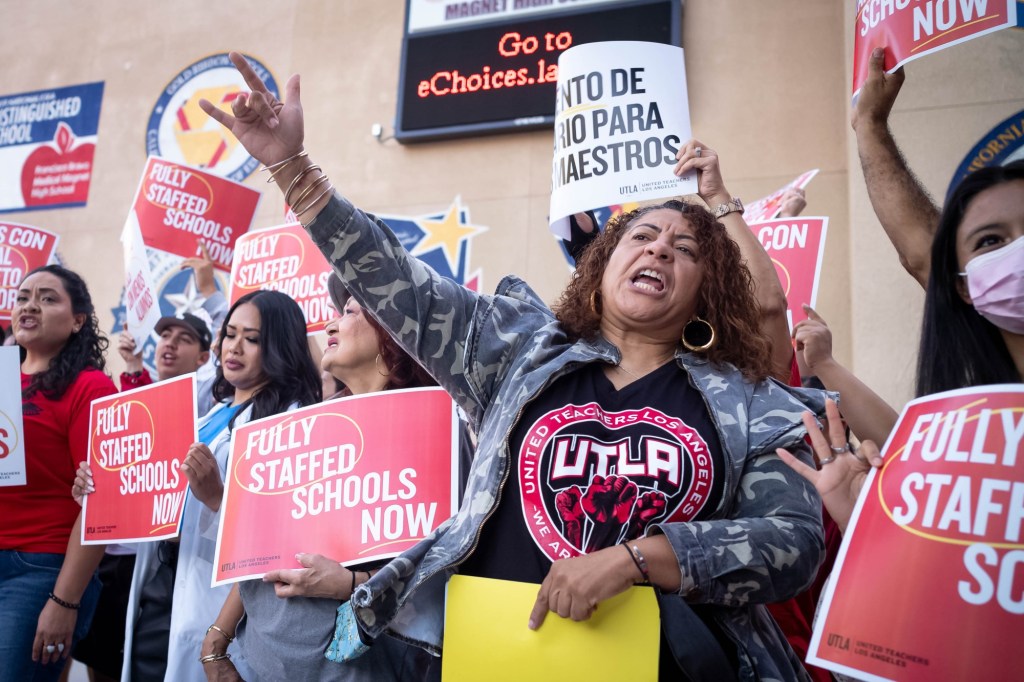
While no doubt there are myriad factors that go into this, the stagnant, union-dominated, accountability-proof nature of the state’s K-12 system is a major impediment to reform and progress. Instead of ever solving the underlying problems, the default move is to paper over failure by lowering standards (often in the name of “equity”).
Many Californians and most government school parents are all too aware of this.
“Half of adults (50%) and a solid majority of public school parents (62%) would favor tax-funded vouchers that would allow them to send their children to any public, private, or parochial school they choose,” reported the nonpartisan Public Policy Institute of California in April of this year.
That’s an impressive level of support for school vouchers considering they’re basically never talked about in California. The state’s teachers unions certainly will continue to stand in the way of them and demonize any effort to introduce and bolster choice, competition or accountability in California’s K-12 system.
For the last decade, the state’s teachers unions and their allies in Sacramento and school boards across the state have cracked down on charter schools, one of the few avenues for innovation and reform in California’s government school system.
Parents are still trying to get their kids in them when they can. “As the state’s traditional public school population continues to decline, charter school enrollment has risen to nearly 728,000 students, accounting for 12.5% of all public school students across 1,280 campuses and independent study programs,” reported EdSource in July.
Beneath the surface of majority complacency with one-party, union-allied Democratic domination of our state politics, there’s clearly a desire for more choice and competition in our K-12 education system.
As enrollment in government schools continue to plummet, as costs rise and as academic preparedness continue to stagnate, something has to give.
Sal Rodriguez can be reached at salrodriguez@scng.com
