



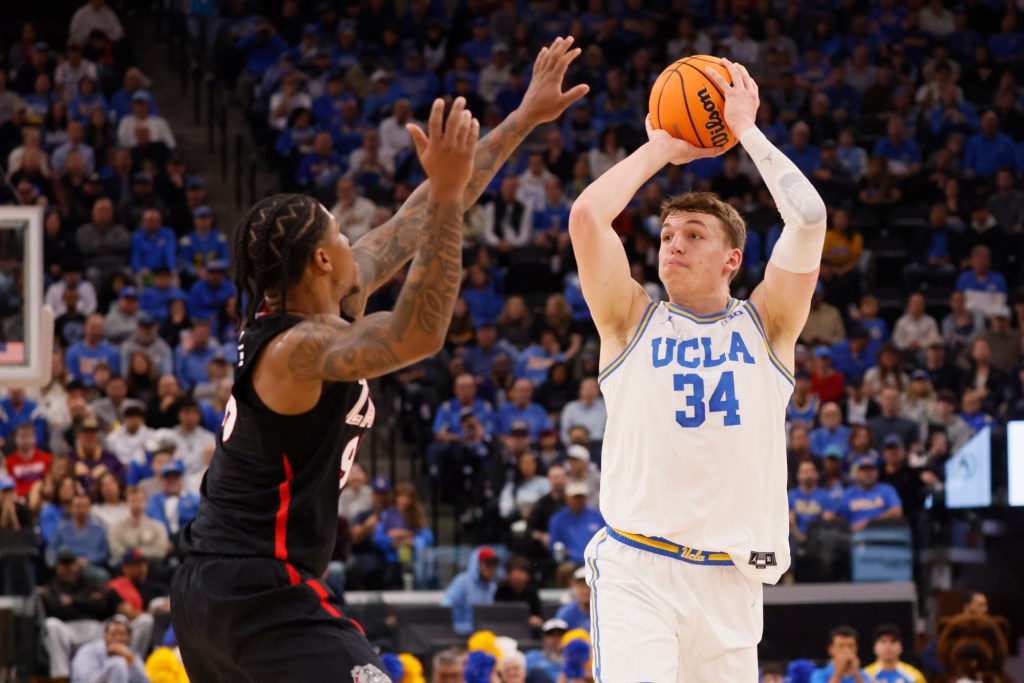

LOS ANGELES — A bubble in Indianapolis, a beach in Maui, a futuristic dome in Inglewood, it doesn’t matter where these West Coast powerhouses meet, the final moments tend to decide the game.
This iteration of UCLA and Gonzaga will be a measuring stick for the 25th-ranked Bruins (7-2), who are rounding into form after a choppy start. They beat Washington and Oregon to open Big Ten play and will play consecutive contests with a fully healthy lineup for the first time this season. For the eighth-ranked Bulldogs (9-1), it’s a business trip as they try to earn their fourth win against a ranked opponent.
It’s the fifth time these nonconference foes have met in the past four calendar years. Their rivalry, however, has evaded their home courts in Westwood and Spokane. In 2025, the stakes will be decided Saturday night in Seattle’s Climate Pledge Arena.
Neutral-site games between two juggernauts have become commonplace across college basketball. UCLA will have participated in three such events, including the Empire Classic against Cal in San Francisco’s Chase Center and the Hall of Fame Series against Arizona in the Intuit Dome.
These neutral-site games appeal to the Bruins because of the national attention they draw and the atmosphere they provide, but most importantly, the monetary value that can be gained.
“They raise money for our program to buy players,” UCLA head coach Mick Cronin said Thursday. “Everybody else can talk about recruiting, write about why kids pick schools, I don’t have time for it. I’m too old. I’ve done enough. It’s comical.
“Guys pick schools because they get paid. These neutral-site games help raise money … that’s why we’re playing the game.”
Cronin needs a hefty budget to put UCLA in a position to succeed. These neutral-site games are an avenue for increasing that capital. The more revenue the Bruins generate, the better chance for these games to return to campus in the future.
To organize a neutral-site game, for example, the promoter, Intersport, selects UCLA and Gonzaga to appear in the Seattle Hoops Showdown. It partners with a TV provider – like ESPN – and offers premium prices for tickets. Intersport then sets a guaranteed payout for each school involved.
For the Bruins, that money flows directly into their third-party collective, Men of Westwood, which uses the funds to fulfill current contracts with players and compete to acquire future assets.
“It’s beneficial to the program anytime it can get exposure and profit from that,” Ken Graiwer, the head of Men of Westwood, told the Southern California News Group. “We should be taking these opportunities.”
Cronin and Men of Westwood are working in tandem, Graiwer said, to lift UCLA back to “its rightful place among the elite college basketball programs.” In this era, that requires dollars. The Bruins will have profited “millions” after Saturday with the combined payout of the exhibition against San Diego State in the Viejas Arena, the Empire Classic, the Hall of Fame Series and the Seattle Hoops Showdown.
In fact, Cronin said, appearing in those events totaled more than if they had played in the Players’ Era, a multi-team event held during Thanksgiving week in Las Vegas that ensured each participating program $1 million in NIL funds.
“We look at everything to raise money,” Cronin said.
It comes, however, at the expense of students parading across campus, down Bruin Walk and into the student section. No confetti will be tossed when the Bruins score their first basket Saturday.
“I’m sure everyone would have liked to have had Arizona or Gonzaga in Pauley Pavilion,” Graiwer said. “But to leave the amount of money on the table is a foolish decision.”
Graiwer, a season-ticket holder himself, admitted he’d prefer these games remain local, to be included on the docket for season-ticket holders. It’s simply nonsensical with the Bruins’ goals and the budgets of the programs they consider peers.
Playing neutral-site games can help alleviate a responsibility from the fans and donors to fund the program, adding another source of third-party revenue.
“We need to put the best team out on the court at all times,” Graiwer said. “Well, do you continue to just go and ask your fans to underwrite everything in terms of NIL, or when you know you’re going to get a six- or seven-figure check, shouldn’t you be taking that money even if it’s at the expense of one game being on campus?”
Beyond the financial benefits, neutral-site games offer competitive advantages. A home game against an opponent with a top-30 NET ranking counts as a Quad 1 result, whereas at a neutral-site, the Quad 1 range extends to top-50 opponents. Therefore, UCLA’s loss to Cal, which currently ranks 54th in NET, could easily rise to a Quad 1 loss because it was played at the Chase Center.
While Cronin doesn’t heavily weigh that as a pro for playing neutral-site games, it’s an added incentive.
Professional arenas also tend to host NCAA Tournament regionals, so gaining experience in those atmospheres early in the season can prove helpful during March Madness. Last year’s UCLA-Gonzaga game, also promoted by Intersport and won 65-62 by the Bruins, took place at the Clippers’ Intuit Dome.
None of those reasons, however, compare to the almighty dollar. Money is the fulcrum behind the rise in neutral-site games. They are the present and the future, while home-and-home matchups remain a tradition of the past.
For UCLA, it will stay that way until these neutral-site games, and other revenue sources, enhance the budget to a point where the Bruins feel comfortable and confident that scheduling a home-and-home won’t hinder their competitive stature.
“If you take away money from your budget to play someone at home, and you don’t have the talent level that we expect to have because you couldn’t meet the salary demands of certain talented players, how do you get it done?” Graiwer said. “The more that we can work on NIL, then you have the potential of one of these games coming back to campus soon.”
No. 25 UCLA (7-2) vs. No. 8 Gonzaga (9-1)
When: 8:30 p.m. Saturday
Where: Climate Pledge Arena, Seattle
TV/radio: ESPN/AM 790
