



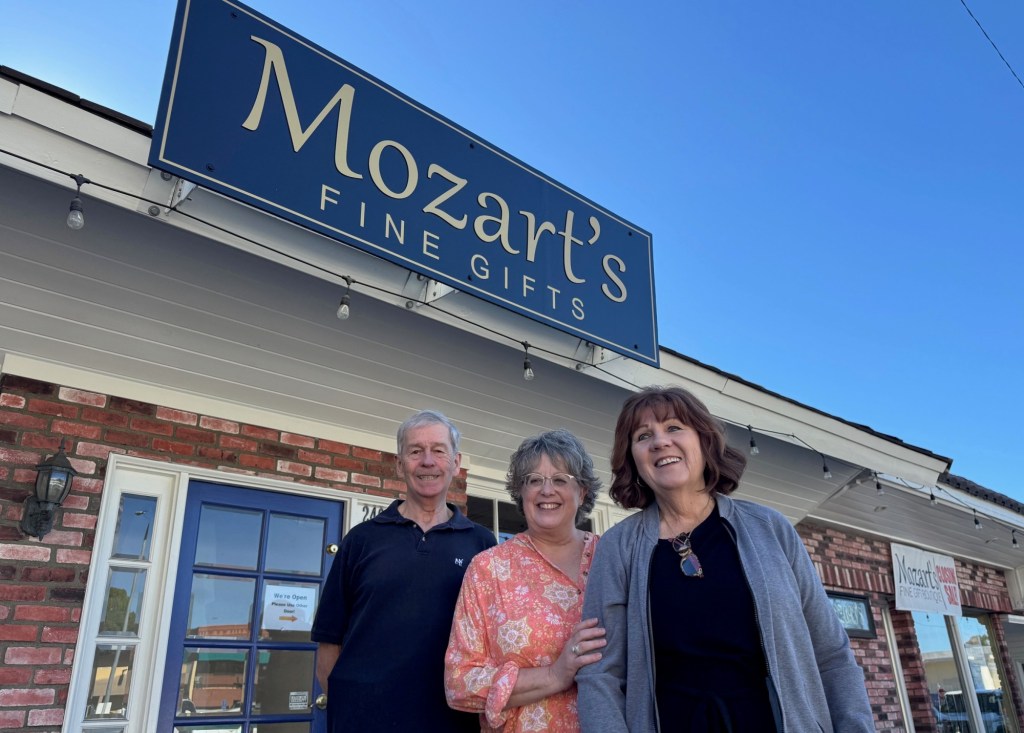
The Redlands shop specialized in women’s and children’s clothing, housewares, greeting cards, silk florals and more. It was named Mozart’s Fine Gifts despite having nothing to do with classical music.
A bit like a composer or conductor, though, owner Dorothea Dinmore sought to transport people to another realm.
Elaborate and colorful displays, quality items, attentive service, fine gift wrap and, yes, classical music were all part of making Mozart’s a haven from everyday life.
Dinmore died suddenly in June at age 75, just as she was planning to wind the store down after 45 years. A closing sale began Sept. 2 and is expected to end in mid-December.
There was little left to buy on my visit a week ago, but people were finding stuff to buy regardless. Employees looked around sadly at the remnants of what had been a lovingly curated space.
“People are coming in and saying, ‘I’m just coming in to buy pieces of Mozart’s,’” Ronda Jolley, a 25-year employee, said.
A San Bernardino reader, Norma Baltich, had phoned after my column on the closing of Riverside’s Stephenson Cree to say that Mozart’s might deserve some ink here too. Always here to serve, I met at Mozart’s with Jolley, manager Susan Martinez and Ian Dinmore, the British-born man who was Dorothea’s husband for 52 years.

While I had no experience with their store, I took a chance and brought up Barbara Cheatley’s, a boutique and gift shop in Claremont from 1975 to 2021. Dinmore said it was a good comparison.
His wife, who grew up in Claremont, had helped run the Cook’s Nook, one of the shops at the Griswold’s complex, and later befriended Cheatley, especially as their type of store became rare in the age of online shopping.
How did Mozart’s start? And why the name?
Dorothea Dinmore was teaching high school in Orange County when a friend in the import business alerted her that a client’s shop in Redlands was for sale. It was a sandwich shop, Julius’ Deli, whose German owner had some German-themed gift items.
The young couple bought Julius’ in 1980. Reflecting her mother’s Austrian roots as well as her family’s love of music, Dorothea renamed it Mozart’s.
Providentially, she wrote a brief history of her business earlier in 2025.
The deli’s sideline of gift items expanded into a small room for customers to browse in, until Dinmore had a realization: The gift business, not corned beef sandwiches, was her real passion. In 1990 she sold the deli to concentrate on retailing.
Mozart’s initially focused on music boxes, dolls and other collectibles but gradually added clothing, housewares and other items. The store expanded three times as adjacent retail spaces along Citrus Avenue became available. Eventually Mozart’s was more than 2,500 square feet, or “a mini department store,” as Dinmore’s essay put it.
My recent walk-through gave hints of what she’d meant. Martinez showed me the warren of small rooms in the back: one for dishes, one for little tables, one for pictures, one for florals, one for wrapping.
“Christmas, there was nobody better,” Martinez said. Two people were dedicated to wrapping gifts. A sticker would be affixed to each. It had a delicate silhouette of a fairy in a forest and the slogan “It Must Be Mozart’s.”

Jolley and Martinez showed me photos on their phones of store displays of the past. Last spring, a mannequin was posed atop a table in a gown of leaves, her head crowned with a wreath of silk flowers, a small elk at her side. Near her feet were small clocks, a lamp and a candelabra.
“I envisioned creating a world of peace, beauty, music and kindness,” Dinmore wrote in her essay. “This should be a tranquil refuge for everyone who enters the store… You’ve often told me that you’re not at Mozart’s to shop but just had to be there because you’d had a bad day and needed cheering up.”
A “coffee corner” let customers, or their patient husbands, make a cup, eat a cookie and relax.
According to a 2005 Redlands Daily Facts story, Mozart’s had “an in-house poet” who penned “handmade cards of blessings” that were placed inside each gift based on the occasion.
The staff showed me a lapel button that tried to sum up the store’s effect. It read: “If I die in Walmart please drag my body over to Mozart’s.”
Business did slow as the customer base aged and wasn’t refreshed.
“We could never get the younger crowd. We had the grandma crowd,” Jolley said with a smile. “Older people see the value of things.” Earlier, she’d said: “We’re a throwaway society.”
Millennials, Ian Dinmore mused, are less interested in owning things and storing them.
By 2024, Dorothea Dinmore began to tire of retailing. Ankle surgery had limited her mobility, and spending time with her granddaughters seemed a better use of her 70s.
The couple sold one of the buildings, shrinking the Mozart’s footprint to a more manageable size. Mozart’s 45th anniversary was celebrated in April. Privately, Dinmore wrote a farewell letter to her customers to be shared at the appropriate time.

But time ran out. She was experiencing great pain. Doctors couldn’t diagnose it at first. It turned out to be advanced spinal cancer.
“Diagnosis to death was 23 days,” Ian said. His wife died at home in hospice care June 19.
A teacher by trade, Ian had only a support role at the store. The closing was announced and Dorothea’s farewell letter sent to customers.
It began: “To my dear cherished customers and friends.” It ended: “With heartfelt thanks for your years of support and friendship.”
Her death passed almost without notice, at her request, following the example of her mother.
“She did not want any fuss. She did not want a funeral. She did not want any announcement to be made,” Ian said. He observed wistfully: “She probably didn’t know how much she meant to people.”
Janis Smith of Loma Linda was in the store clutching an armful of silk ferns. She’d been in several times to buy “little reminders, little mementos” of the place she’d loved as an elementary school teacher and was sad to see closing.
“After a long hard week,” Smith told me, “I would come here to just look, hear beautiful music, see beautiful things, smell beautiful fragrances. It was a treat to come in on a Friday. A treat.”
For the Mozart’s family, that sentiment might be music to their ears.
David Allen writes Wednesday, Friday and Sunday, three grace notes. Email dallen@scng.com, phone 909-483-9339, and follow davidallencolumnist on Facebook or Instagram, @davidallen909 on X or @davidallen909.bsky.social on Bluesky.
