



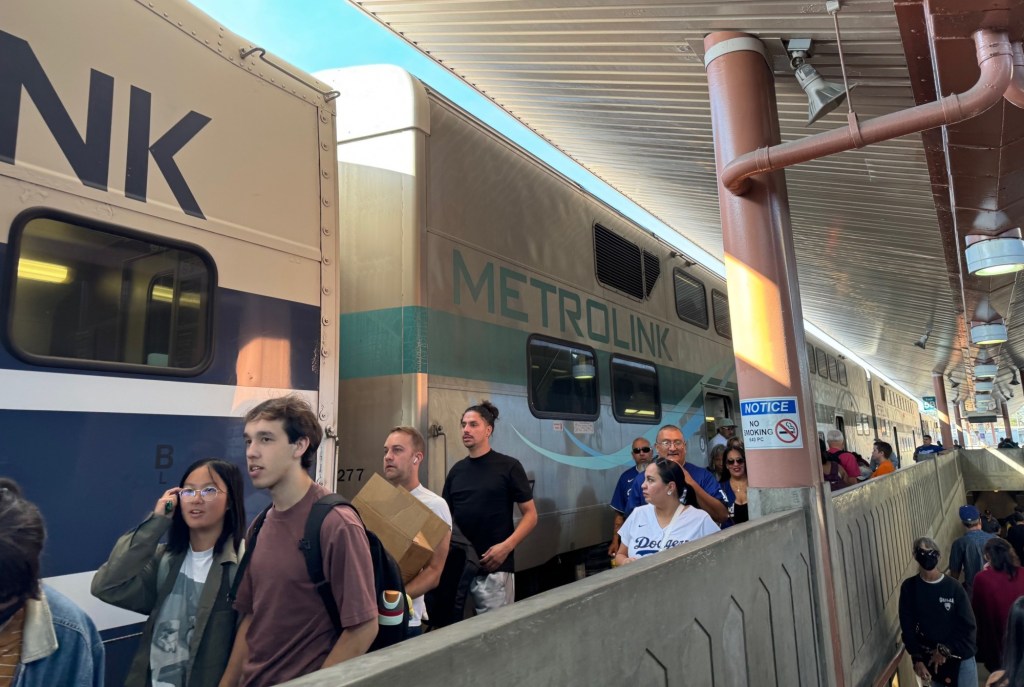

The San Bernardino County Transportation Authority’s recent decision not to continue negotiations with the Foothill Gold Line Construction Authority on the A-Line extension into our county has generated strong feelings on both sides.
Some viewed the proposal as an opportunity to expand transit service, while others, myself included, saw it as a case study in duplication, inefficiency, and escalating cost at a time when fiscal discipline and accountability to taxpayers are more important than ever.
While this decision has prompted a healthy debate, it also gives us the chance to focus on something that is already working: Metrolink’s San Bernardino Line.
For decades, this line has been the backbone of commuter rail service for our county, connecting San Bernardino, the San Gabriel Valley, and downtown Los Angeles. It is the busiest line in the Metrolink system and carries thousands of riders each day. The infrastructure is established, the ridership is strong, and the opportunity for modernization is significant. Rather than spending scarce dollars to create a parallel service, we should enhance what already serves our residents.
That opportunity became even clearer with the recent completion of LA Metro’s A-Line extension to Pomona. By connecting directly to the Metrolink San Bernardino Line, this project has achieved a continuous rail link that allows bi-directional access between the San Gabriel Valley and San Bernardino County.
This new connection means riders can now travel east or west more freely, transferring between the two systems with greater convenience and efficiency. In many ways, the network that many desired has already been realized.
It is also important to acknowledge that extending the A-Line to Montclair is not a new idea. It has been in discussion for decades, and the SBCTA Board has consistently supported it in good faith. However, with the passage of time, the circumstances have changed. Costs have continued to escalate, timelines have stretched, and new technologies have emerged to reshape what is possible. After years of planning and patience, it became appropriate to take a step back and recalibrate our strategy with what truly serves the public best today.
One of the most exciting developments in this new landscape is the introduction of the Zero Emission Multiple Unit, or ZEMU, the first fully Federal Railroad Administration compliant zero-emission commuter train in North America. Developed by the San Bernardino County Transportation Authority, the ZEMU represents a major leap forward in both environmental performance and operational flexibility. It operates quietly, produces no tailpipe emissions, and allows for service levels that can adjust quickly to demand. These improvements are already strengthening the San Bernardino Line and positioning it for the future.
This innovation also aligns with other forward-looking transportation projects in our region. The privately funded Brightline West high-speed rail service, which will connect at the Rancho Cucamonga Station, will create a powerful link between Southern California and the High Desert. Together, Brightline West and the ZEMU help form a seamless, modernized rail network that builds upon existing success rather than duplicating it. These efforts bring value to the entire corridor and support economic growth in communities such as Montclair, Upland, Rancho Cucamonga, Fontana, Rialto, San Bernardino, and Redlands where new investment is tied to reliable and frequent transit.
Meanwhile, the proposed A-Line extension into San Bernardino County has faced mounting challenges. While expanding transit service is an admirable goal, the extension would have run entirely parallel to the Metrolink San Bernardino Line. At a time when every public dollar must be carefully managed, it makes little sense to duplicate rail service in the same corridor. Continuing in that direction would consume large amounts of funding that could instead deliver near-term improvements to Metrolink. Enhancements that address frequency and reliability for thousands of current and future riders.
Recognizing when a long-planned project no longer aligns with present realities is not a failure of commitment; it is an example of sound leadership. The decision to pause, reconsider, and redirect investments toward the greater good is precisely what taxpayers expect and deserve.
That is why the SBCTA Board’s decision to end negotiations on the A-Line extension was not a retreat from progress but a reaffirmation of it. By focusing on strengthening Metrolink, we are honoring decades of regional collaboration while embracing new opportunities that make more sense for today’s riders and tomorrow’s economy.
Ultimately, this conversation comes down to good governance. Effective leadership requires not only vision, but also the discipline to adapt as conditions evolve. It demands transparency, fiscal responsibility, and an unwavering focus on public benefit. The taxpayers who fund our transportation system deserve to know that their money is being used wisely and that projects are guided by need, not nostalgia.
Metrolink’s Southern California Optimized Rail Expansion (SCORE) program is a model of this approach. It invests in the system we already rely on, preparing for more frequent, bi-directional service throughout the day. These improvements will reduce congestion, improve air quality, and create more equitable access to jobs and education across the region. They reflect the kind of smart, scalable progress that moves the county forward without unnecessary duplication or expense.
The San Bernardino Line has carried our county for decades, connecting people, communities, and opportunity. With continued commitment and careful investment, it can carry us even further. By focusing on the system that already serves us well, we can build a cleaner, faster, and more connected future. A future that reflects the best traditions of regional partnership and the highest standards of good governance.
Larry McCallon is Mayor Pro Tem for the city of Highland, a San Bernardino County Transportation Authority (SBCTA) Board Member and former chair of the Metrolink Board of Directors.
