



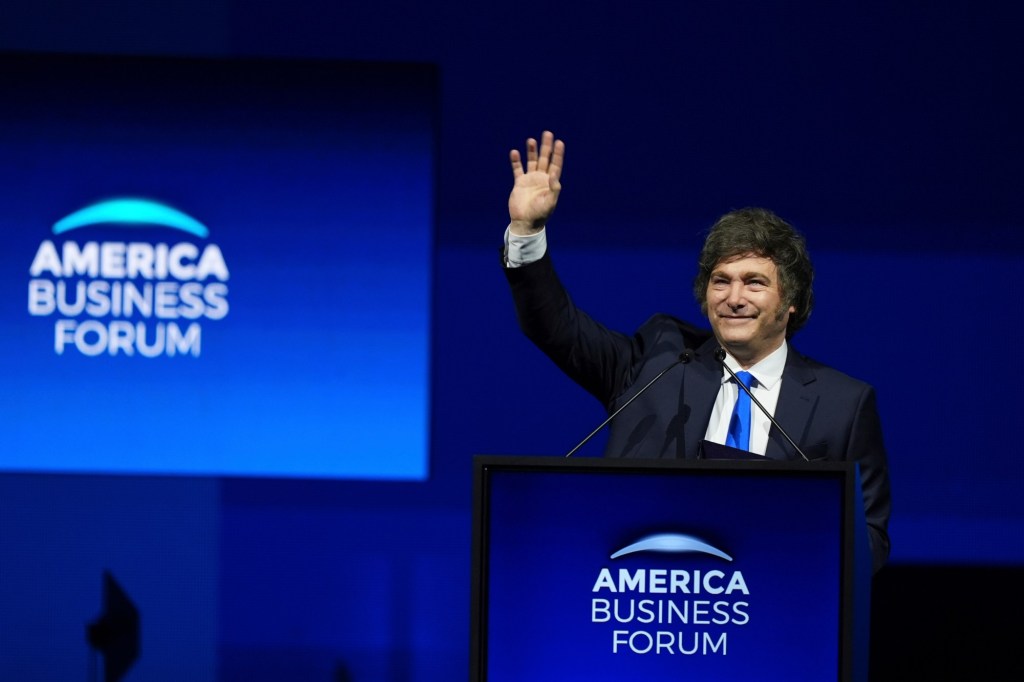

Two years ago, on December 10, 2023, President Javier Milei came to power in Argentina, promising free-market-friendly reforms and to rid the country of the economic chaos it has endured for decades.
In November, I visited Argentina and got to see first-hand the impact of Milei’s economic agenda. While decades of bad policy are still impacting the economy, and many people continue to struggle, Milei’s pro-free market agenda is showing early results as evidenced by the economic activity I witnessed in the country.
Prior to Milei, the Kirchnerist government, led by Peronist Cristina Kirchner (now doing time for corruption), brought Argentina’s economy to its knees. Their last stint in office with President Alberto Fernández culminated in an inflation rate of 25.5% month-on-month, and 211.4% year-on year. (For context, the inflation rate under President Biden, which many Americans found unacceptable, averaged 4.95% year-on-year.).
I had visited Argentina just as Fernández was leaving power in 2023. I witnessed how stores didn’t even display prices because they would change daily. I spoke to family and friends who told me it was impossible to conduct business and plan their personal economy that way—they didn’t know how much they’d be making in a month, and had no sense of how much goods and services actually cost. It was chaotic.
At the time, economic activity was slow. Not many people were spending money. I saw many closed businesses and few shoppers. Businesses were hesitant to sell goods because sky-rocketing inflation meant they might lose money on products. The country’s GDP shrank 1.5% year-on-year—evidence of a bad economy.
Argentina seemed poised to repeat Venezuela’s mistakes. It was partly because of this dire economic situation that Argentinians elected the pro-free market outsider Javier Milei.
Fast forward to my visit in November 2025, and I saw a completely different picture than in 2023. Inflation has dropped to 2.3% month-on-month and 31.3/year-on-year as of October 2025. In my hometown of Córdoba, I saw much more economic activity than two years prior. Restaurants were full, even on weekdays. Malls were well-attended. International brands like Vans, Victoria’s Secret, and Tommy Hilfiger started opening stores in the city—a non-trivial sign of a more stable economy (a phenomenon also happening in Buenos Aires).
Talking to people there, the broad consensus was that they were better off now than they were two years ago. Most said it’s still hard to get by as salaries haven’t caught up with rising costs caused by austerity measures (for example, Milei ended subsidies for services like gas, electricity and transportation, making those services costlier to consumers)— but also remark that they feel economically safer now. A construction CEO told me that “the predictability afforded by a lower inflation rate is priceless,” and that he can better plan for his business now. A video producer agreed with this sentiment: He expressed that he still finds many goods and services to be expensive, but that the stability brought by lower inflation allows him to have a better sense of the cost of his own work.
Milei brought down inflation by stopping Argentina’s chronic deficit spending and the money-printing that financed it. He cut public spending at a massive scale by, among other things, eliminating ministries and government jobs, cancelling public works, slashing subsidies in many areas, and committing to a “zero deficit” policy. Simultaneously, he deregulated markets to reduce distortions that kept prices high (for example, by eliminating rent control).
What I witnessed in Córdoba in early and mid-November tracks with reports that showed a 21% increase in tourism across the country compared to last year.
This is largely the consequence of Milei’s freedom-friendly economic agenda. For decades, state leaders, chiefly the Peronists, persuaded many Argentinians that, if the government didn’t intervene in the economy, people wouldn’t survive. Along came Milei with a deregulating agenda that got rid of price controls, tamed inflation, created a fiscal surplus for the first time in 14 years, and created a hospitable environment for foreign investment, among other measures.
Not everything is rosy in Milei’s Argentina. Many are still struggling. (The average monthly salary in Argentina is just over $1,000 —far from salaries in developed economies.) Some don’t agree at all with Milei’s approach, and many across the political spectrum (including myself) have concerns about some of Milei’s agenda outside of economic policy.
But Milei must be commended for beginning to turn the economy around, inching Argentina closer to economic freedom, and showing Argentinians that embracing more freedom is not catastrophic as previous leaders told them—but is, in fact, much better than the alternative.
Milei’s economic approach seems to be working so far, and I’m glad to see my country of birth slowly getting back on its feet.
Agustina Vergara Cid is a Young Voices contributor. Follow her on X: @agustinavcid
