


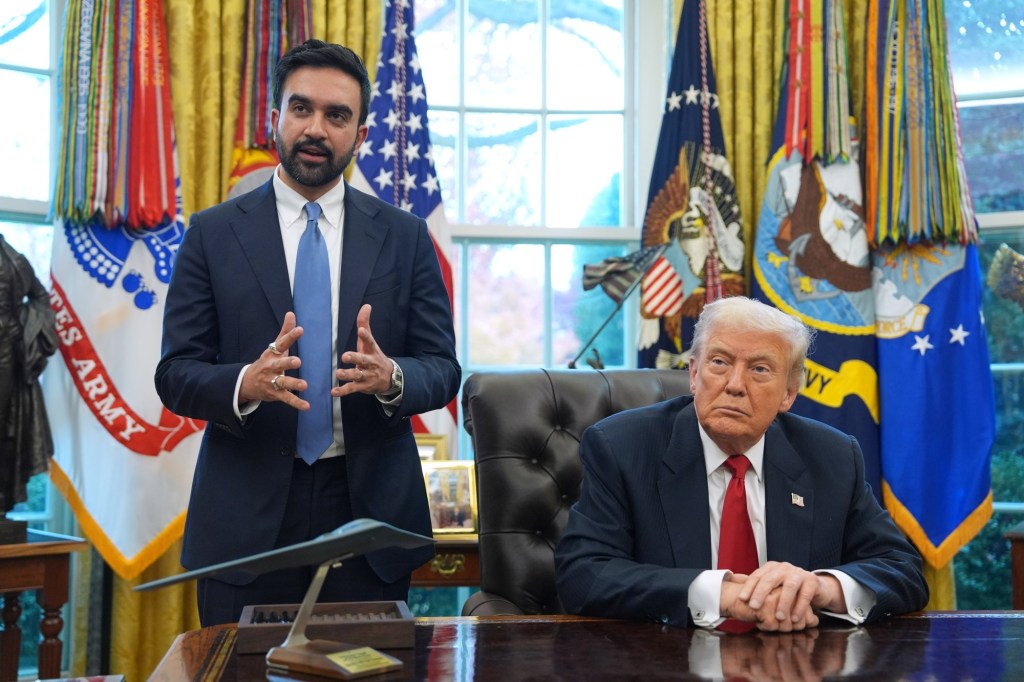

It’s been said many times before, but it bears repeating: Donald Trump is not a conservative.
Many commenting on American politics use the term conservative to describe anyone on the right side of the political spectrum, but that is inaccurate.
Conservatives, libertarians, nationalists and populists are all distinct from each other but are all too often lumped together as one. It’s just as false to say liberal, progressive and socialist are all the same. Sure, all three might want to raise my taxes, but that doesn’t mean they’re identical philosophies.
Throughout the 20th Century, conservatism grew in America largely in response to the New Deal and the growing threat of Marxism, through great minds and publications like Russell Kirk, National Review, William F. Buckley and Sen. Barry Goldwater. The movement emphasized limited government, self-reliance, liberty, morals and free markets and sought to assert America’s influence throughout the world, promoting democracy and opposing communism.
Decades of hard work culminated in the Reagan revolution and the fall of the Soviet Union.
History lessons are boring, so forgive me. But it’s important to give a little background to show that this term didn’t come out of nowhere.
Buckley, Reagan and others made conservatism cool. Young voters were embracing conservative philosophy, with Reagan leading significantly with voters under 30 in his 1984 reelection, and everyone on the right tried adopting the label.
There was always tension between conservatives and others on the right. Buckley didn’t like President Dwight D. Eisenhower because he was too moderate (i.e. not conservative) or President Richard Nixon because he was too cozy with communist China and degraded the presidency regarding Watergate (again, not conservative). He also shunned John Birch Society founder Robert Welch for promoting conspiracy theories and author Ayn Rand for promoting atheism and selfishness.
Buckley and conservatives were able to find areas of agreement with politicians like Nixon and Eisenhower, and could vote for them over liberal opponents, but much of what the non-conservatives did offended conservative principles.
Which brings us to the present moment: many conservatives might support some of Trump’s actions and might see him as the more palatable choice against a liberal, but that doesn’t mean he is a conservative.
Trump doesn’t govern like someone interested in limited government. In fact, he’s expanded government power at times and attempted to consolidate power for himself at other times. Trump’s use of executive orders and his novel interpretations of the Constitution have sought to seize more power for the Executive Branch than many of his predecessors. In this he is much closer to Franklin D. Roosevelt than he is to George Washington.
Trump has used his powers to attempt to punish rivals, indemnify supporters and enrich his family. You could say, especially on weaponizing the Department of Justice to go after rivals, that that’s what former Presidents Joe Biden and Barack Obama did to him, to which I’d say “those guys aren’t conservatives either.”
Trump is not a fiscal conservative. Sure, he’s cut some programs, like the haphazard DOGE initiative, but he hasn’t reduced government spending, or the federal deficit, or the debt. In fact, all three continue to grow.
Conservatives believe that America is exceptional, that our American Experiment stands alone as a beacon of hope and self-governance throughout the globe. Trump says he’s America first, though his policies are undercutting American ideals, alienating allies, favoring authoritarians and shrinking American influence abroad.
Conservatives believe in liberty and free-market economics. Trump’s widespread use of tariffs is taxing American citizens to fix a non-existent problem (our trade deficit is a sign that America is wealthy; it’s not necessarily a bad thing). It’s anti-free market and harms consumers desperate for cost-of-living relief and undermines businesses that rely on trade.
Furthermore, Trump professes to oppose Marxism but shakes down American companies like Intel and Nvidia to get ownership stakes and profit-sharing for the federal government. It’s hard to get more Marxist than public ownership in private enterprise.
Trump is anti-federalist and is hostile towards states that disagree with him. He is anti-expertise; his cabinet has many people grossly unqualified for the jobs they hold (though others are fine choices). He is boorish and lacks character; his petty statement airing grievances after the murder of Hollywood legend Rob Reiner stands out as a perfect example.
Sure, Trump has found common ground with conservatives. He appointed conservative Supreme Court justices who, among other things, returned the question of abortion to the states, and he has sought to roll back the Department of Education. But he is best explained by horseshoe theory, which suggests that political ideology is a horseshoe, not a line, where extreme views on the right and left get very close to each other at the ends. This would explain him surrounding himself with many current or recently former Democrats (himself included) and his many policies that align more with progressives.
Trump is on the political right, but, love him or hate him, he is not a conservative.
Matt Fleming is an opinion columnist with Southern California News Group. Follow him on X at @flemingwords or email him at flemingwords@gmail.com
