



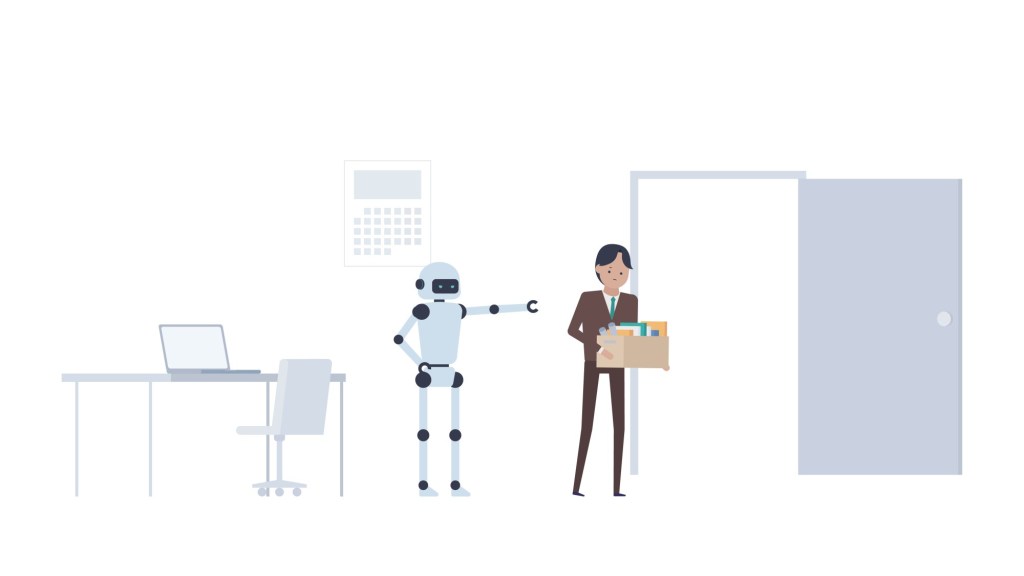

At some point in the future, AI and robotics will be advanced enough to perform nearly all of the jobs currently performed by humans. Such a future will require that we radically change the relationship that we have with the economy and the means of production. Corporations will be forced to share their revenues as a universal basic income if they want to exist at all.
However, before we achieve complete automation, there will be a period of gradually increasing AI adoption that will present unique challenges that cannot be so straightforwardly remediated (relatively speaking) as a world with full automation.
So, what does a world look like where artificial intelligence has led directly to an unemployment rate comparable to or exceeding that of the Great Depression (25%)?
High unaddressed unemployment is associated with poor outcomes by nearly every metric. As desperation and resentment take root, persistent unemployment is positively correlated with crime, social unrest, and mental disorders.
Developing economies like India and the Philippines who have depended on being centers of AI-replaceable, outsourced service and IT jobs will be among the first casualties. According to an International Labour Organization report, in the Philippines, 89% of these jobs are at high-risk for automation. These nations will have to quickly transition millions away from such roles or be faced with even greater poverty.
Clearly then, a partial but substantial AI adoption will produce extreme challenges to our world well before we achieve complete automation. One sense in which this should cause particular concern is that solutions to this problem will appear complex and elusive.
A universal basic income, the intuitive solution to complete automation does not seem to be appropriate in the short term when AI is not yet dominant. UBI has been proposed by people like Andrew Yang as a supplement to wages but critically, not as a livable wage on its own.
We can appreciate the unsuitability of UBI when we consider the likely outcomes of its different forms within this short-term AI scenario in which AI becomes increasingly but not completely dominant in a relatively short period of time – we can adopt either a bare-bones UBI with a low standard of living or a high UBI where individuals receiving it are at least content with their standard of living.
Let’s assume that, here in the United States, a psychologically satisfactory UBI would be about the current average yearly income in America, which is about $62,000. Setting aside the fact that this would cost multiples of the entire federal budget, we would create a population that would be largely disincentivized to take up the jobs that AI would not yet be capable of performing.
We could instead set UBI below the psychologically acceptable threshold for Americans. A significant portion of the population would be forced to live, at most, very modest lives that they are unhappy with while having virtually no recourse to improve their lives given the lack of employment opportunities. Having 30% of our population essentially locked into poverty is a recipe for social deterioration and instability, at least with a bare-bones UBI on its own.
Addressing the short-term dangers of automation, especially if its impacts come rapidly, will take a monumental intervention. The government may have to go so far as to combine a modest UBI with a massive jobs creation program and weekly work limits to make individuals share jobs. We will no longer have the luxury of enjoying a meritocracy precisely because discriminating on the basis of competence would lead to the same unemployment. Our attitudes toward work and earning your way in life will become obsolete when social mobility and economic autonomy are eliminated for vast portions of the population.
If humans become increasingly obsolete and unable to sell their labor, the benefits of a capitalistic system will no longer be salient for a growing number of people. The reason so many advocate for free markets and capitalism is because it allows for gains in overall wellbeing. When that ceases to be the case, capitalism will have to be abandoned.
So far we’ve considered an oversimplification of both the problem and the solutions. The severity will depend on numerous factors such as how many jobs automation creates, the scale of retraining, the speed at which automation happens, how quickly we preempt or respond to these changes, and all sorts of background conditions.
The problem of AI-induced mass unemployment is one that government should start working on now to avoid rather than respond to – it will be more challenging to address if we must do so during an economic downturn and while people go hungry. The resulting system will be unrecognizable, but it is one that will come about out of pure necessity.
Rafael Perez is a columnist for the Southern California News Group. He is a doctoral candidate in philosophy at the University of Rochester. You can reach him at rafaelperezocregister@gmail.com.
