



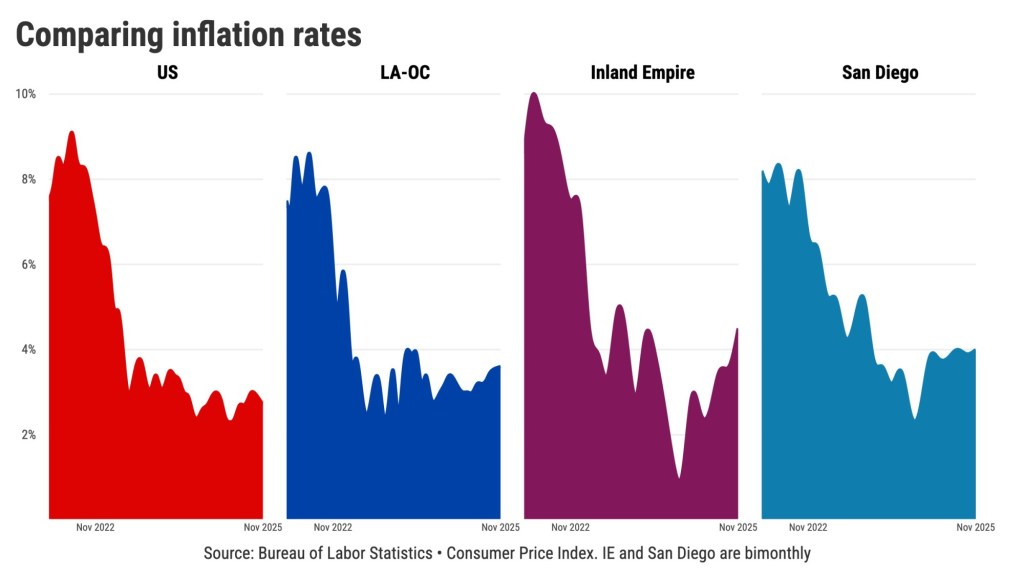

The nation’s reportedly slightly cooler inflation has not reached Southern California.
My trusty spreadsheet looked at the first Consumer Price Index report in two months to see how the cost of living behaved during the federal government’s historic shutdown, both nationally and across three local regions.
The overall U.S. inflation annual rate was 2.7% in November, down from 3% in September. However, progress is modest.
The last time U.S. inflation, as measured by CPI math, was below 2.7% was in May. And November was equal to the 2.7% rate in November 2024. That’s when Donald Trump won his second White House term and promised to quickly fix the nation’s cost-of-living woes.
It’s a different price picture across Southern California.
The Inland Empire posted the region’s fastest inflation rate of 4.5% in November, the highest since September 2023. This was up from 3.6% in September and 1.1% a year earlier.
San Diego County’s inflation rate rose to 4%, the highest since November 2023, up from 3.9% in September and 2.6% a year earlier.
And in Los Angeles and Orange counties, the 3.6% inflation rate was the highest since May 2024. It was 3.5% in September and 3.2% a year earlier.
Ponder some key consumer spending categories within the CPI to get hints at the gaps.
Cooling rents
Price hikes from landlords moderated nationally and in most local regions, as measured by the CPI.
U.S. rents rose at a 3% annual rate in November vs. 3.4% September and 4.4% a year earlier.
L.A.-Orange County rent grew at a 3.4% annual rate in November, off from 3.6% in September and 4.5% a year earlier.
San Diego rents grew 3.9% year over year in November, down from 4% in September and 4.7% a year earlier.
Yet in the Inland Empire, renters paid 5% more in a year in November – down from 5.6% in September but double 2.5% a year earlier.
Goosed by groceries
Costs at the supermarket were mixed.
Nationally, food-at-home prices rose at a 1.9% annual rate in November vs. 2.7% September and 1.6% a year earlier.
L.A.-Orange County’s grocery inflation ran 2.3% in November, down from 2.8% September but faster than the 2% a year earlier.
In the Inland Empire, groceries were 1.1% pricier for November, slower than 1.3% inflation for September – but a reversal from a 0.1% drop a year earlier.
And in San Diego, grocery prices dropped 0.1% in November. That’s an improvement from a 2% gain for September and a 2.4% increase a year earlier.
Pump pain
Last year’s dip in gas prices is a memory – but that pain is greater locally.
Nationally, unleaded regular prices rose at a 0.7% annual rate in November, up from an 8% decline a year earlier.
L.A.-Orange County pumps were priced 8% higher in the year ended in November, erasing much of the 13% drop a year earlier.
In both San Diego and the Inland Empire, unleaded was 7% more expensive in November than a year earlier, down from a 12% drop a year earlier.
Pruned pay hikes
Local inflation hurts even more as raises shrink.
One yardstick of wages and salaries in Los Angeles, Orange, Riverside, San Bernardino and Ventura counties showed compensation growing at a 3.4% annual rate in the third quarter, down from 4.8% in 2024.
Nationally, the Employment Cost Index showed raises slowing to a 3.6% annual rate from 3.8% in the third quarter of 2024.
Jonathan Lansner is the business columnist for the Southern California News Group. He can be reached at jlansner@scng.com
