



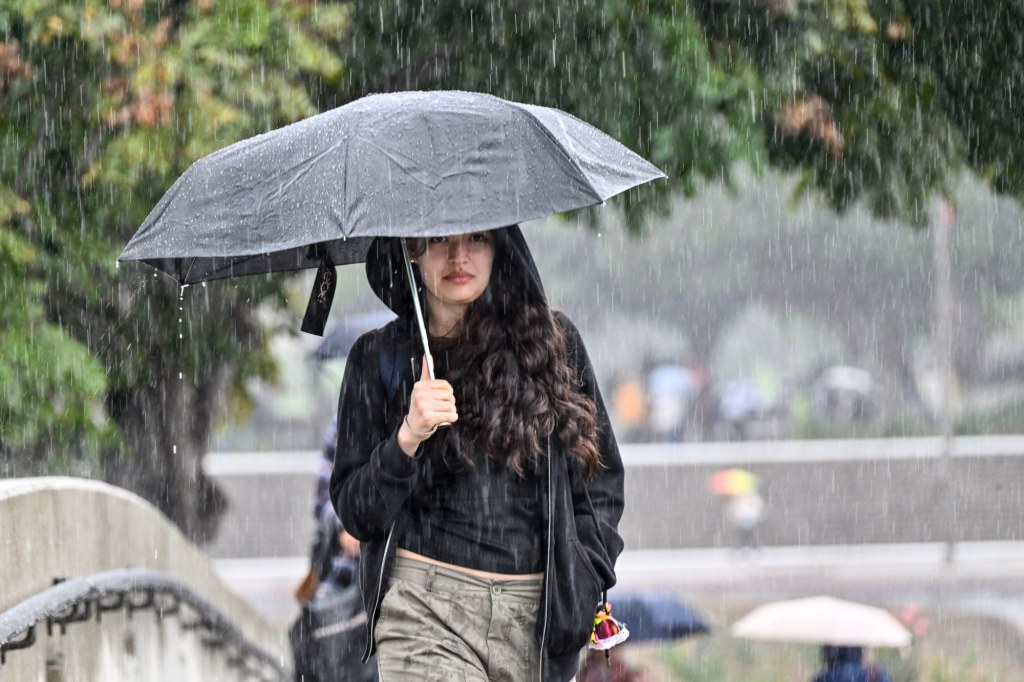

It may not be a white Christmas in Southern California, but it could be a wet — and potentially record-setting — one, as a storm system is expected to bring widespread rain across the region during the holiday.
A plume of subtropical moisture — often referred to as an atmospheric river — is forecast to move south into the region beginning as early as Tuesday night, bringing periods of rain to Los Angeles, Orange, Riverside and San Bernardino counties through at least Christmas Day, according to the National Weather Service.
There remains uncertainty regarding the storm’s timing and intensity, though confidence is increasing that rainfall will be widespread, said NWS meteorologist Kyle Wheeler.
Forecasters expect the heaviest rain to fall on Wednesday, with additional lighter showers possible on Christmas Day.
In Los Angeles County, 2 to 4 inches of rain are possible across metro areas from Tuesday night through Christmas, with up to double that amount in foothills and mountains, according to NWS meteorologist Bryan Lewis. The last time downtown Los Angeles saw more than 2 inches of rain on Christmas Eve was 1971, and the last time it saw more than 2 inches on Christmas Day was 1946, Lewis said.
Across Orange, Riverside and San Bernardino counties, lower elevations are expected to receive 1 to 3 inches of rain, while higher elevations could see 3 to 5 inches or more, Wheeler said.
Some areas could also challenge longstanding Christmas rainfall records. In Orange County, the highest recorded rainfall on Christmas Day is 1.21 inches, set in 1988, according to NWS meteorologist Lauren Villafane. In San Bernardino County, the Christmas Day rainfall record stands at 1.90 inches, also set in 1988, while Riverside County last saw more than 1.14 inches on Christmas Day in 1940, Villafane said.
Temperatures are expected to remain mild, with highs in the 60s across coastal and valley areas through Christmas. Thursday, Dec. 18 appears to be the warmest day before gradual cooling over the weekend, Lewis said.
Snow is not expected for populated areas, but colder air arriving around Christmas could lower snow levels to between 5,500 and 7,000 feet, including in the Wrightwood area, Lewis said.
Forecasters warned the storm could make travel difficult, with reduced visibility and slippery roads and an increased risk of flooding and debris flows, particularly in foothill and mountain areas, as rain falls through the holiday period.
