



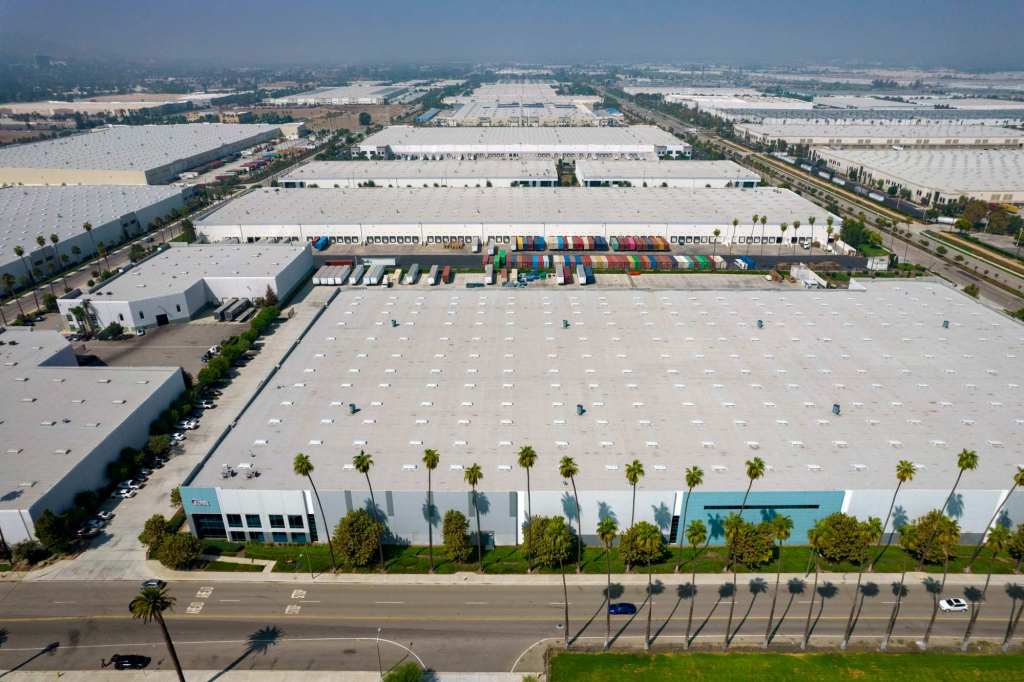

Growing up with childhood asthma, I knew exactly where my sickness came from: the air pollution billowing from the thundering I-5 freeway next to our house. For kids from Southern California’s Inland Empire (IE), my story is far from unique. The IE suffers the worst smog of any major metropolitan region in the United States, driving disproportionately high rates of pediatric asthma and respiratory illness. The culprit? An endless stream of diesel trucks servicing the region’s massive logistics infrastructure: over one billion square feet of warehouse space and distribution centers.
Over the past three decades, cheap land costs, an expansive transportation network, and proximity to the Ports of Los Angeles and Long Beach transformed the IE from vineyards and orchards into a sprawling concrete jungle with a population greater than half of the states.
While the logistics industry has brought great wealth and development, it has also cost local residents. The industry provides low wages, poor working conditions, little social mobility, and is rapidly adopting automation technologies that eliminate jobs. In one of the country’s fastest-growing regions already facing a dire housing shortage, ever-expanding industrial zones consume land that could instead better house families and support the region’s high growth industries like healthcare, biosciences, clean energy, and hospitality.
As the Inland Empire looks toward its future, overreliance on the logistics industry presents one of the region’s greatest challenges. Demand for warehouse space continues rising with e-commerce growth, but as cities permit more warehouses, they further exacerbate dangerous levels of housing insecurity, pollution, congestion, climate disasters, socioeconomic inequality, and economic dependence, with lower-income neighborhoods and communities of color bearing the greatest burden.
Already, local communities are beginning to push back. A recent law prohibits warehouses from being constructed within 300-500 feet of homes, schools, and other sensitive sites, to protect people from direct pollution exposure and deadly truck collisions. In Riverside, residents are organizing against the city’s proposal for a new commercial park.
Undoubtedly, the logistics industry will and ought to continue playing an integral role in the IE’s economic fabric. However, too much of the industry’s burdens are concentrated in one region, and too much of our future is staked on its continued growth.
Instead, cities should prioritize the permitting, financing, and development of new housing, alongside supportive transit and schools, instead of warehouses (the IE also has the lowest education levels in the state).
To reach a conventionally affordable housing market (<30% of a household’s budget goes toward housing), California already needs to build at least 2.5 million units. And with the IE’s population projected to double by 2050, the housing shortage crisis is becoming ever more salient and consequential. Furthermore, this new housing–especially dense, multifamily housing–can create land use supportive of transit and small businesses, spurring more sustainable economic activity, job growth, and tax revenue.
Reducing our reliance on logistics will be a difficult but necessary task to chart the course for a more green, healthy, equitable, and economically sustainable IE. I envision for our community a future where our children breathe clean air and see their economy and built environment not as obtrusive and deadly, but instead as expansive and full of opportunity.
Rohan Chowdhury is a masters student at Stanford University and was raised in Rancho Cucamonga. He has worked in transportation planning and urban policy at several government agencies across California and Oregon.
