



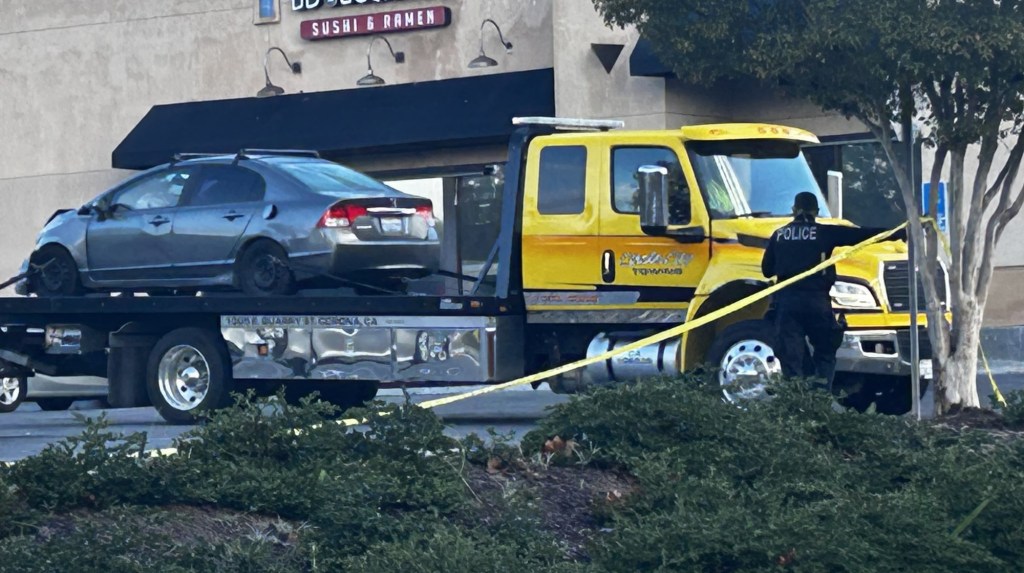

The man who Corona police shot to death on Tuesday, Nov. 18, was a 31-year-old Corona parolee with convictions for felony assault and resisting arrest, Superior Court records show.
Kiavik Galarza Miranda died in the parking lot of the Applebee’s restaurant on McKinley Street after two officers fired separate volleys of shots as Miranda twice advanced on them and they retreated. A video shows Miranda, as officers fire for the second time, moving briskly toward them while holding a tire iron that witnesses said he had swung menacingly before officers arrived.
Police also said Miranda crashed his car into another, injuring that driver.
Miranda was charged with crimes in San Diego County in 2016, 2017, 2018 and 2021.
In a case filed in 2021, Miranda was sentenced to eight years and eight months in state prison after pleading guilty to assault with a deadly weapon, resisting arrest and evading police, all felonies, in an elder abuse case. The criminal complaint shows that Miranda was convicted in 2018 of assault with a deadly weapon with a sentencing enhancement of causing great bodily injury.
It was unclear Thursday when Miranda was released from prison.
Meanwhile, the state Department of Justice has taken over the investigation into the officers’ actions from Riverside County authorities under a state law that requires the state to probe whether a fatal police shooting of an unarmed civilian was lawful.
The DOJ considers a person unarmed if they “are not in possession of a deadly weapon,” according to the agency’s website. That definition, however, is highly nuanced.
Possession usually requires that the weapon is available for immediate use. The person could be considered unarmed even if officers had seen the suspect with the weapon moments earlier but he no longer held it.
“They only look at that split second of when that trigger is pulled to determine whether it fits their criteria,” said Sgt. Robert Montanez, a Corona Police Department spokesman.
And a deadly weapon can be a firearm or similar to a knife or metal knuckles, but also everyday items such as bottles, chains, vehicles and iron bars, the DOJ website says. But even then, those items are considered deadly weapons only when “they are actually being used in a manner likely to produce death or great bodily injury.”
Miranda appeared to be holding, and not swinging, the tire iron, so it was unclear whether the DOJ believed the tool was “used” as a deadly weapon.
“It comes down to investigators’ interpretation,” Montanez said.
The Police Department will conduct a separate investigation to determine whether the officers’ actions complied with department policy.
