



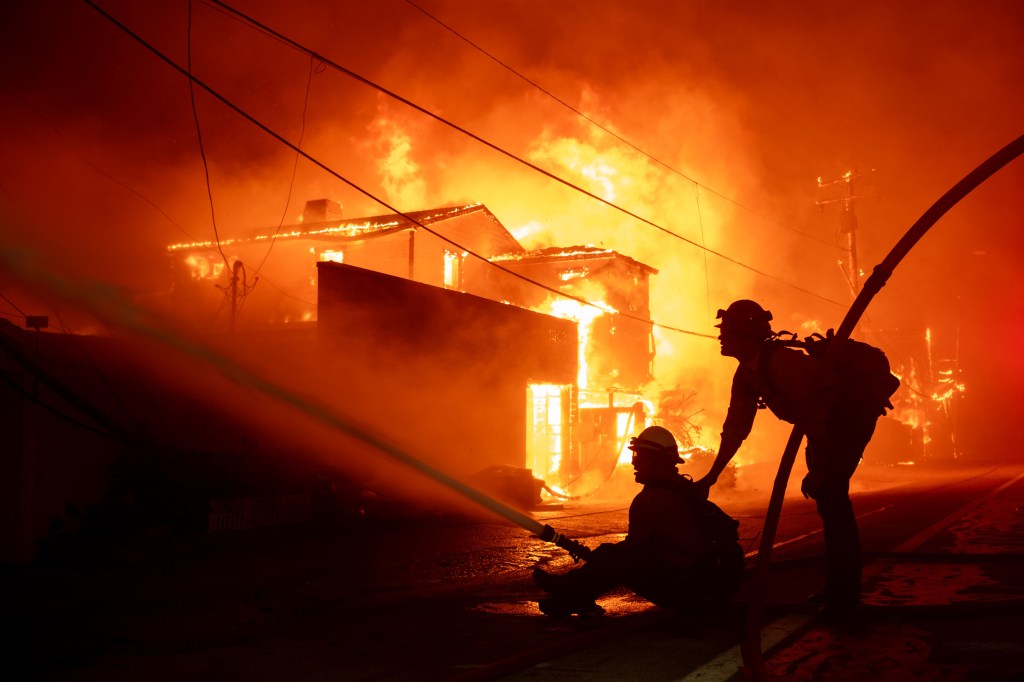

Imagine being fined $1.9 million for trying to prevent a catastrophic wildfire that would destroy lives and property in Pacific Palisades.
That’s what happened to the city of Los Angeles, specifically the city-owned Department of Water and Power, in 2020. The California Coastal Commission fined LADWP for the work it had started in Topanga State Park in 2019 to improve fire safety. The utility was replacing old wooden power poles, widening roads for fire department access and replacing power wires to improve their resistance to wind and fire.
It just so happened that a hiker and amateur botanist, walking through the park, saw the LADWP work in progress and reported what a spokesperson for the Coastal Commission called “unpermitted bulldozing through an area of endangered plants and hiking trails in Topanga State Park.”
The project had damaged nearly 200 Braunton’s milkvetch plants. According to the Sierra Club, there were only 3,000 of these plants in the local mountains. The Braunton’s milkvetch is on the federal endangered species list.
Sadly there was no list to protect the endangered homes that were destroyed and the lives that were lost in the Pacific Palisades in January. If there had been a list, perhaps the Los Angeles Fire Department could have thrown it in the faces of the environmental bureaucrats who created the conditions for the catastrophic fire that resulted from the failure to fully extinguish the January 1 Lachman fire in Topanga State Park.
Palisades resident and fierce advocate Spencer Pratt reported on the X platform on November 15, “I spoke with a fire chief that was told by a Newsom state representative that the LAFD could NOT bring in a dozer to the Lachman fire site because of protected plants.”
On the state’s website at wildlife.ca.gov, Californians can read all about the laws protecting native plants: “Important California laws for native plant protection are the California Endangered Species Act (CESA), the Native Plant Protection Act (NPPA), the California Environmental Quality Act (CEQA), the Natural Community Conservation Planning Act (NCCPA), the California Desert Native Plants Act (CDNPA), and California Penal Code Section 384a.”
It appears that the milkvetch has an entire building full of lawyers to protect every purple petal, all of them paid by the human taxpayers who get no such protection.
In 2020, LADWP was required not only to pay the $1.9 million fine but also to perform erosion control, undo any grading that had been done, replant the areas and implement a long-term program to monitor the damage from widening trails with bulldozers for the purpose of fire safety.
One thing LADWP did not agree to do was apologize.
Courthouse News reported that Brian Wilbur, the director of power transmission and distribution, refused to issue a public apology for the work that was done by LADWP crews. Instead, he pointed out that the power lines were the “main arteries” that provided electricity to the coastal neighborhoods and upgrading the poles and power lines was necessary for wildfire safety.
“It is crucial that we perform the work that’s needed with a focus on environmental stewardship,” Wilbur said.
In 2023, concerned Palisades residents were told by California State Parks District Superintendent Richard Finks II that the state does not do brush clearance on park land because “We’re here to protect the natural habitat.”
Back in 1992, the Los Angeles Times reported that “state and national parks officials say they have become reluctant despoilers of wildlife habitat because local fire-control rules require them to strip native vegetation from scores of parkland sites in the Santa Monica Mountains.”Then-superintendent of the Santa Monica Mountains district of the state Department of Parks and Recreation Dan Preece told the Times, “We would like to see the impacts of fuel reduction kept at a minimum in the parks.”
Looks like he got his wish. By 2025, the leadership of the Los Angeles Fire Department would tell firefighters on the ground at the Lachman fire, with the land still smoldering, to pick up and leave.
In 1992, the fire department probably could have responded to the National Weather Service’s warnings of dangerous wind conditions by revisiting the site of that fire to ensure the protection of lives and property.
Today, people are secondary to plants.
Write Susan@SusanShelley.com and follow her on X @Susan_Shelley
