



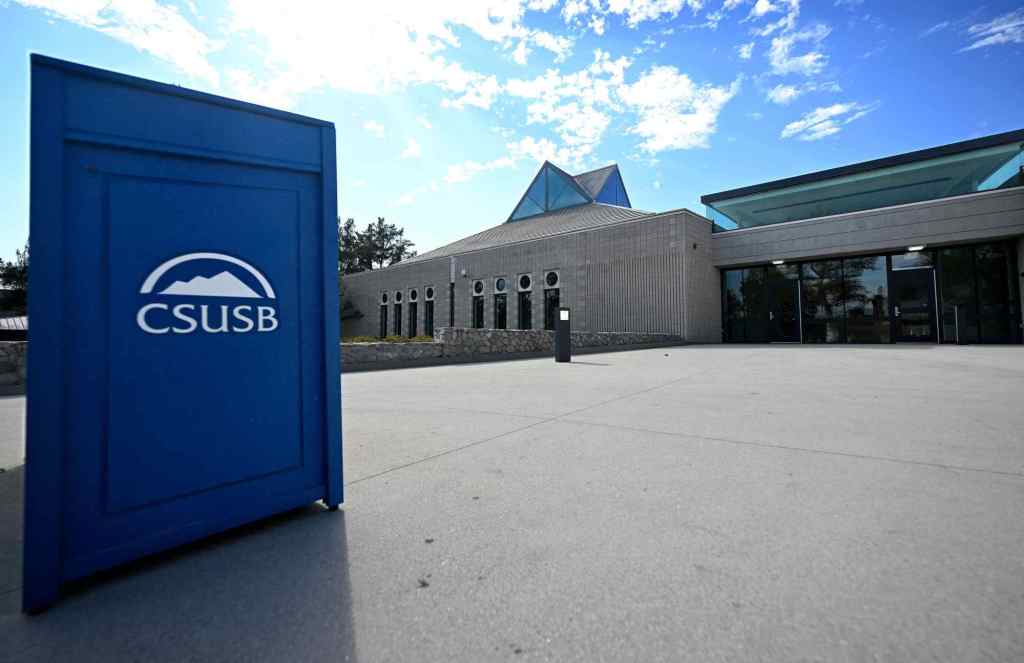

After failing to get its long-awaited physician assistant program off the ground, Cal State San Bernardino is disputing the denial of accreditation that prevented the program from starting.
The university’s Master of Science in Physician Assistant program did not receive the provisional accreditation it needed to launch, campus officials have said. In July, the Accreditation Review Commission on Education for the Physician Assistant would not accredit the program, officials said.
RELATED: Cal State San Bernardino’s physician assistant program fails to launch
The program aimed to address the Inland Empire’s severe doctor shortage and to help fill workforce gaps in a region that faces challenges in access to healthcare, officials said.
Forty students were supposed to start the 27-month-long program in August, officials said, and were notified of the failed accreditation just before classes were to begin. In the aftermath, a number of staff and faculty members who worked on setting up the program also were let go or told they would lose their jobs this year.
The university appealed the commission’s decision, but in August the panel stood by the denial, leaving school officials to say in a Thursday, Nov. 6, statement that they will “review its options” for reapplying for the accreditation.
Heather McGovern, a senior manager of program accreditation with the commission, said by email Friday, Nov. 7, that the panel did not have a comment.
In response to a California Public Records Act request seeking the final accreditation report, the university provided an Aug. 8 commission letter denying the university’s appeal and repeating the citations from the report.
The commission cited eight reasons for the denial, many centered around what it considered to be a lack of support staff — including faculty, administrative and technical employees — to help run the program and to “fulfill obligations to matriculating and enrolled students.”
“The Commission’s Executive Committee did not see evidence that the program had sufficient faculty or personnel to begin the program,” the letter states.
In the university’s statement, provided by Cal State San Bernardino spokesperson Robert C. Tenczar, officials said the region “has the most significant healthcare access gaps of any major metropolitan area in California.”
“We remain steadfast in our commitment to helping fill that void through superior and culturally responsive PA education,” the statement read. “Our entire campus team has worked diligently to incorporate what we have learned over the past three years of program development into policies and practices that meet or exceed … (the commission’s) appropriately high standards,” and that of other educational, Cal State and federal expectations around “equitable employee treatment.”
The statement added that Cal State San Bernardino “remains confident in our program’s compliance,” and will “continue to dispute the findings” in the panel’s accreditation denial.
The university has voiced concerns to the commission, according to its statement, and alleged it had “unethical, clandestine communication” between “certain disgruntled faculty members and commissioners.”
The university alleged that the commission made decisions “based on factors outside of the published standards,” “did not follow published processes” or allow due process when reviewing formal complaints,” made “obvious and impactful clerical errors in the review of key documents,” had “no interest in rectifying them,” and “gave preferential treatment to other applicant programs who did not have to utilize the poorly functional online application portal.”
It also alleged that the commission “financially benefitted from breaking their processes, amassing $20,000 in additional fees.”
Southern California has at least 12 institutions with accredited physician assistant training programs, with some provisional or in development. The commission’s website shows at least 20 accredited programs in California. Cal State San Bernardino’s would have been the only one in the 23-school Cal State system, and the first at an Inland Empire public university. The university itself is fully accredited.
A physician assistant can diagnose and treat patients as well as perform procedures under a doctor’s supervision. Research shows that more physician assistants will be providing primary care due to the nation’s doctor shortage. Physician assistant programs are 2 to 2 1/2 years long — much shorter than the training to become a doctor.
In her response to the university, commission President/CEO Sharon Luke cited a lack of “sufficient principal faculty to meet the academic needs of students and manage administrative responsibilities.” Her letter, addressed to Cal State San Bernardino Provost Rafik Mohamed, informed the school that it may withdraw from the accreditation process or request a formal appeal hearing. University officials said Thursday, Nov. 6, they would “review its options.”
In its final evaluation, the accrediting panel cited eight reasons for the university’s “noncompliance” with its standards, many related to the “insufficient faculty” issue, according to the letter. The commission also pointed to numerous internal personnel and job title changes, expiring or unsigned employment contracts and concerns over what it called a lack of tenured, full-time faculty members who would be employed long enough to run the program.
During the university’s years-long process of applying — which began in 2022 — commissioners pointed out that some staff members, who helped develop and would be running the program, were not classified as full tenured faculty at the time accreditation was sought — one of the panel’s main requirements.
The accrediting body also stated that learning objectives, as well as student evaluations, should be more clearly defined, and that class syllabi and clinical rotation information should be more detailed. The commission did several site visits during the application process.
In its statement, university officials stated that the school received conditional approval of accreditation, but that the commission withheld final accreditation “based primarily on claims that the university provided fraudulent employee contracts.”
One former program employee, who spoke on the condition of anonymity because she feared retaliation, said the university “didn’t actually take the time to do what was right by the ARC-PA standards.”
“If they took into account what everyone is saying and made some changes, this could have been avoided,” the employee said. “It was too little, too late.”
The new master’s program was to be housed in a state-of-the-art remodeled building, formerly known as the Yasuda Center for Extended Learning, officials said.
The completed project — with new classrooms, patient labs, student areas and a clinical exam center — is not being used, ousted program staff members said.
Rosslynn Byous, a former Cal State San Bernardino professor who would have been an instructor in the program, was let go in August. She alleged that during the accreditation process, the university ignored policies and standards, misclassified faculty and was “not in compliance from start to finish.”
Though the university later converted several program staff members into full-time faculty, Byous said, it was “not just a timing issue … it was consistent errors” that the university “ignored” when issues were brought forth.
“They could not prove they had what they needed to open the program,” Byous said. “… If they had made sure we all had contracts … we’d be sitting in that multi-million building right now.”
Program funding came from grants and initiatives and money secured by several public officials, university officials said in an April 2024 news release announcing the program. The project received $10 million in state funding and $2 million from federal grants secured by Rep. Pete Aguilar, D-San Bernardino, and Sen. Alex Padilla, D-Calif. Former state Sen. Richard Roth, of Riverside, obtained more than $16 million for the program in the state’s 2023 budget.
Roth called it “outrageous” that the commission would rely on “minor, fixable” staffing issues and “deny accreditation at the last minute.”
“There has been too much money and time invested by CSU faculty, the state, especially the students,” he said. “It’s not the fault of the university that the commission declined accreditation.”
Roth had helped with funding for UC Riverside’s medical school — which initially failed to win accreditation over funding issues in 2011, but later opened in 2013. He said the Inland region, with its serious healthcare needs and demand for physicians, would benefit from another robust physician assistant program to train future providers. He urged Cal State San Bernardino to reapply.
“A program that could significantly have a positive impact on healthcare in the region is going to be lost,” he said. “It disadvantages students, faculty, staff, you name it, who in many cases reordered their lives and relocated to participate in this PA program. It’s a real tragedy.”
Karen Kolehmainen, a Cal State San Bernardino professor and committee chair in the California Faculty Association union’s San Bernardino chapter, said in a statement that members also hope the university will reapply for accreditation, to “help meet the urgent health care needs of our community, protect the rights of the faculty and staff who have already been hired, and make productive use of the funds that have already been spent on the program.”
